 Add to Chrome
 Add to Firefox
 Add to Edge
STAR-PólyaMath: Multi-Agent Reasoning under Persistent Meta-Strategic Supervision
May 19, 2026
Frontier AI models and multi-agent systems have led to significant improvements in mathematical reasoning. However, for problems requiring extended, long-horizon reasoning, existing systems continue to suffer from fundamental reliability issues: hallucination accumulation, memory fragmentation, and imbalanced reasoning-tool trade-offs. In this paper, we introduce STAR-PólyaMath, a multi-agent framework that systematically addresses these challenges through meta-level supervision and structured Reasoner-Verifier interaction. STAR-PólyaMath is structured as an orchestrated state machine with nested challenge-step-replan loops, governed by a reasoning-free Python orchestrator that separates control from inference and bounds error propagation through trace-back and re-planning. Our key innovation is a persistent Meta-Strategist that maintains cross-attempt memory and exercises meta-level control by issuing high-level strategic guidance or mandatory directives, so the system can escape unproductive loops rather than stagnate or over-rely on tools. STAR-PólyaMath achieves state-of-the-art results on all eight top-tier competition benchmarks: AIME 2025-2026, MathArena Apex Shortlist, MathArena Apex 2025, Putnam 2025, IMO 2025, HMMT February 2026, and USAMO 2026. It obtains perfect scores on AIMEs, Putnam, and HMMT, and shows its largest margin on Apex 2025, scoring 93.75% compared with 80.21% by the strongest baseline GPT-5.5. Ablation studies show that the gains arise from the framework's orchestration rather than from model-level diversity since removing key components or substituting in mixed backbones consistently weakens performance. Code is available at https://github.com/Julius-Woo/STAR-PolyaMath.

Vibe Reasoning: Eliciting Frontier AI Mathematical Capabilities -- A Case Study on IMO 2025 Problem 6
Dec 22, 2025We introduce Vibe Reasoning, a human-AI collaborative paradigm for solving complex mathematical problems. Our key insight is that frontier AI models already possess the knowledge required to solve challenging problems -- they simply do not know how, what, or when to apply it. Vibe Reasoning transforms AI's latent potential into manifested capability through generic meta-prompts, agentic grounding, and model orchestration. We demonstrate this paradigm through IMO 2025 Problem 6, a combinatorial optimization problem where autonomous AI systems publicly reported failures. Our solution combined GPT-5's exploratory capabilities with Gemini 3 Pro's proof strengths, leveraging agentic workflows with Python code execution and file-based memory, to derive both the correct answer (2112) and a rigorous mathematical proof. Through iterative refinement across multiple attempts, we discovered the necessity of agentic grounding and model orchestration, while human prompts evolved from problem-specific hints to generic, transferable meta-prompts. We analyze why capable AI fails autonomously, how each component addresses specific failure modes, and extract principles for effective vibe reasoning. Our findings suggest that lightweight human guidance can unlock frontier models' mathematical reasoning potential. This is ongoing work; we are developing automated frameworks and conducting broader evaluations to further validate Vibe Reasoning's generality and effectiveness.
$M^3-Verse$: A "Spot the Difference" Challenge for Large Multimodal Models
Dec 21, 2025Modern Large Multimodal Models (LMMs) have demonstrated extraordinary ability in static image and single-state spatial-temporal understanding. However, their capacity to comprehend the dynamic changes of objects within a shared spatial context between two distinct video observations, remains largely unexplored. This ability to reason about transformations within a consistent environment is particularly crucial for advancements in the field of spatial intelligence. In this paper, we introduce $M^3-Verse$, a Multi-Modal, Multi-State, Multi-Dimensional benchmark, to formally evaluate this capability. It is built upon paired videos that provide multi-perspective observations of an indoor scene before and after a state change. The benchmark contains a total of 270 scenes and 2,932 questions, which are categorized into over 50 subtasks that probe 4 core capabilities. We evaluate 16 state-of-the-art LMMs and observe their limitations in tracking state transitions. To address these challenges, we further propose a simple yet effective baseline that achieves significant performance improvements in multi-state perception. $M^3-Verse$ thus provides a challenging new testbed to catalyze the development of next-generation models with a more holistic understanding of our dynamic visual world. You can get the construction pipeline from https://github.com/Wal-K-aWay/M3-Verse_pipeline and full benchmark data from https://www.modelscope.cn/datasets/WalKaWay/M3-Verse.
DISC-MedLLM: Bridging General Large Language Models and Real-World Medical Consultation
Aug 28, 2023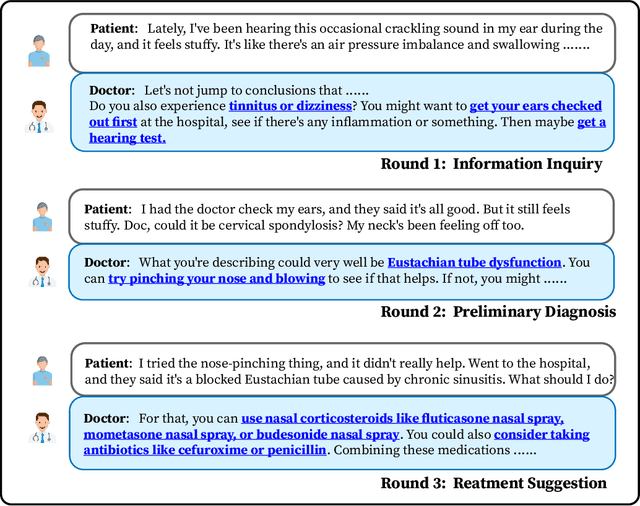
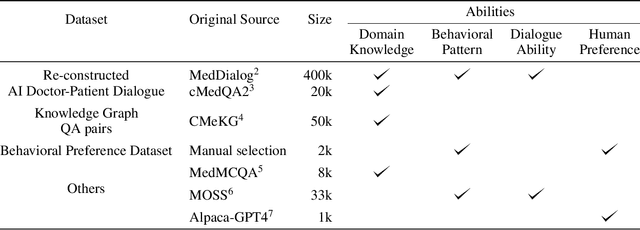
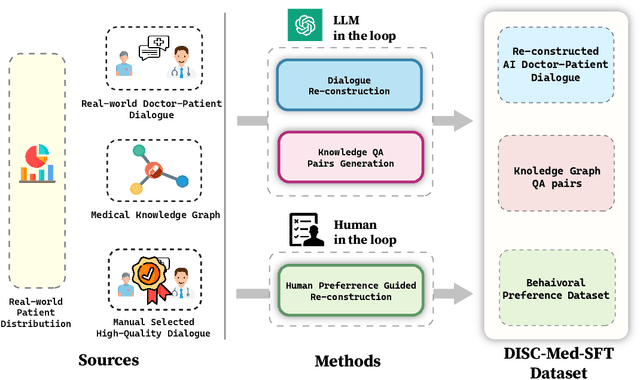
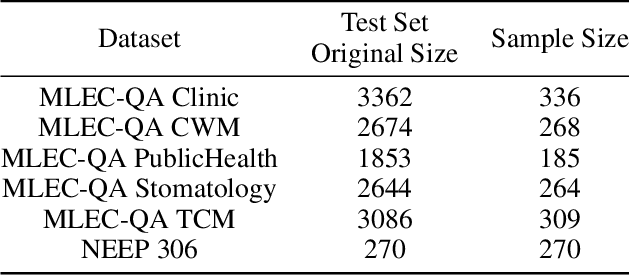
We propose DISC-MedLLM, a comprehensive solution that leverages Large Language Models (LLMs) to provide accurate and truthful medical response in end-to-end conversational healthcare services. To construct high-quality Supervised Fine-Tuning (SFT) datasets, we employ three strategies: utilizing medical knowledge-graphs, reconstructing real-world dialogues, and incorporating human-guided preference rephrasing. These datasets are instrumental in training DISC-MedLLM, surpassing existing medical LLMs in both single-turn and multi-turn consultation scenarios. Extensive experimental results demonstrate the effectiveness of the proposed model in bridging the gap between general language models and real-world medical consultation. Additionally, we release the constructed dataset and model weights to further contribute to research and development. Further details and resources can be found at https://github.com/FudanDISC/DISC-MedLLM